
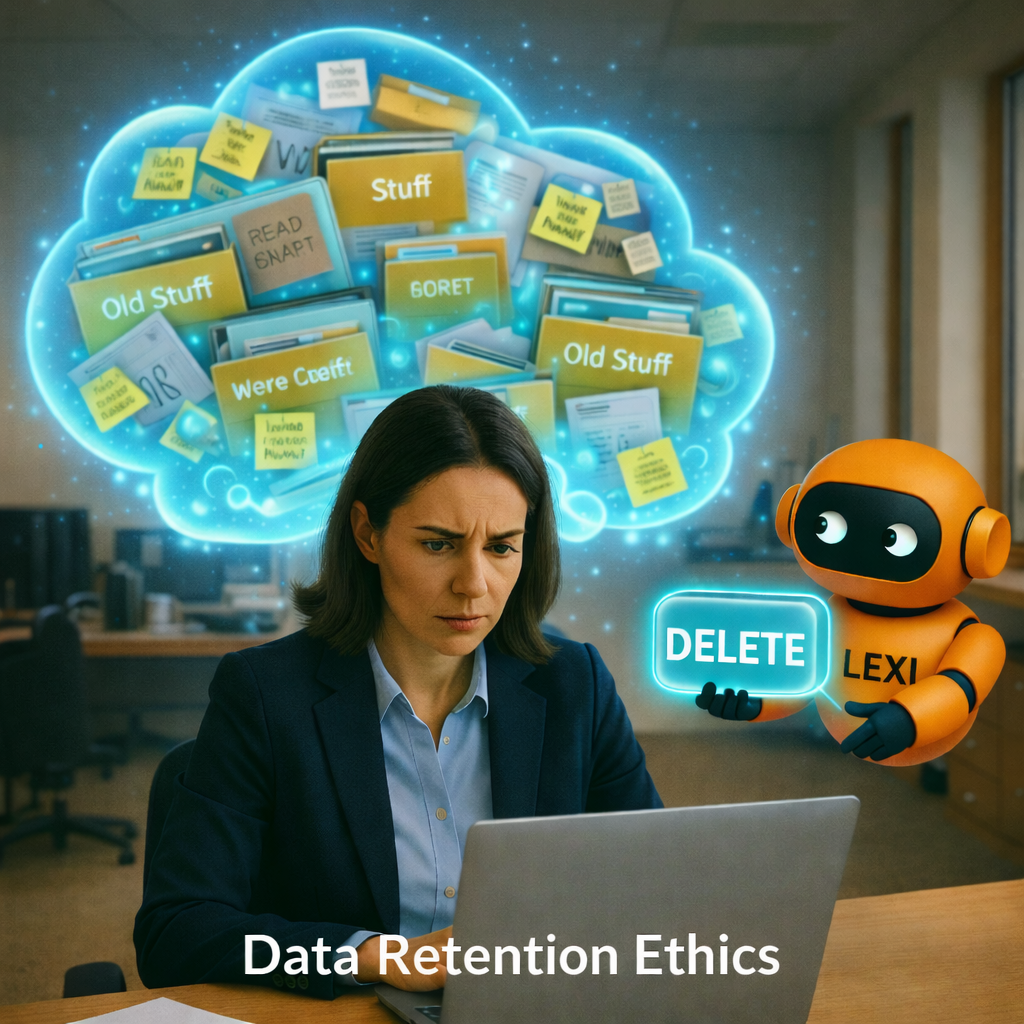
1. Digital Clutter Isn’t Harmless — It’s an Ethical Time Bomb

Lawyers often assume digital retention is harmless:
“It’s just bits. They don’t take up physical space!”
True. But they take up risk space.
Every additional file increases your exposure to:
- Breaches (more data = bigger blast radius)
- Accidental disclosure (attachments, forwarding, wrong recipients)
- Unauthorized internal access (people seeing what they shouldn’t)
- Misfiled or mis-sent data (the “oops” email)
- Discovery obligations you didn’t plan for
- Client demands for old documents you can’t verify
- Outdated information that conflicts with current advice
Think of your firm’s data like food in a fridge. The more you keep, the more likely something is expired, leaking, or waiting to poison you.
Digital hoarding creates ethical chaos because you can’t protect what you don’t even know you have.
2. The Myth of “It Might Be Useful Someday”

Lawyers cling to documents the way law students cling to highlighters: compulsively, irrationally, and with misplaced optimism.
Yes, some documents matter long term. But most of what firms store will never be accessed again—by anyone.
And ethical retention isn’t about possibility. It’s about purpose.
Key question:
If you don’t need it for legal, regulatory, operational, or client-defined reasons… Why are you keeping it?
- “Might be useful” is not a retention standard
- Purpose is the standard (why it exists, who needs it, for how long)
- “Because we always have” is not a policy — it’s a habit
“Because we always have” isn’t a policy. It’s a plotline in a cleanup show.
3. Retention Rules Are Ethical Rules Disguised as Admin Tasks

A proper retention policy is not optional anymore.
It must define:
- What gets kept
- For how long
- Who reviews it
- How deletion works
- When clients can request files
- What happens to backups
- What happens after an engagement ends
- How cloud systems handle retention vs deletion
The danger is that many firms have retention policies but never enforce them.
That’s like having a seatbelt you refuse to wear because “it’s too tight.” When the crash happens, the policy doesn’t protect you.
4. Deletion Isn’t a Dirty Word — It’s a Duty

Many lawyers treat deletion like it’s unethical.
“What if we need it someday?”
Ethics rules don’t require you to be an archive. They require you to protect client confidentiality.
And sometimes the best protection is secure deletion.
Deleting data responsibly:
- Reduces breach impact
- Limits exposure in litigation
- Removes outdated or harmful information
- Prevents unauthorized internal access
- Keeps systems organized
- Strengthens privilege positions
- Aligns with client expectations
Deletion is an ethical shield, not a liability.
5. Cloud Systems Complicate Everything (But Also Solve Everything)

Cloud platforms store: emails, documents, chats, logs, backups, copies of backups, cached versions of drafts, and artifacts you didn’t even know existed.
Cloud is both the problem and the solution.
The problem:
- Deleting something may not delete all versions
- Retention settings vary between systems
- Backups may persist beyond what policies permit
- Users store data in unofficial places (hello, personal Dropbox)
The solution:
- Automated retention schedules
- Access logs that show who opened what
- Data classification to identify sensitive materials
- Centralized systems that replace shadow archives
The point is not to fear the cloud. It’s to understand that cloud retention is its own discipline—and one firms rarely manage deliberately.
6. Client File Returns: The Final Act That No One Plans For

When clients ask for their files back, most firms panic.
Because suddenly someone wants:
- A complete file
- In a specific format
- Within a specific timeframe
- That you weren’t prepared to produce
- From systems not designed for orderly retrieval
- While you’re hoping you didn’t keep anything you shouldn’t have
Ethically, firms must:
- Return what belongs to the client
- Withhold only permissible internal work product
- Do it promptly
- Do it securely
- Prove you know what the “file” consists of
A firm with disciplined data lifecycle management says, “Here you go.” A firm without it says, “Oh no.”
7. Backups: The Silent Complication No One Talks About

Deleting something from the main system doesn’t touch the backups.
If those backups live forever, so does the data. Which means:
- Breach exposure still exists
- Confidentiality still applies
- Retention rules may be violated
- Litigation hold obligations get confusing
- Clients may receive stale or duplicate information
Backups need their own retention schedule. Most firms never create one.
What good is deletion if your data is still camping out in yesterday’s server snapshot?
8. Data Minimization: The Principle Lawyers Resist but Clients Expect

Modern data ethics is built on a simple idea: Keep only what you need. Delete the rest.
Clients increasingly expect firms to follow this principle—especially large corporate clients with strict vendor governance rules.
Data minimization:
- Protects clients
- Reduces firm liability
- Simplifies workflows
- Improves security
- Enhances compliance
- Reduces storage costs
Yet lawyers cling to “saving everything forever,” as if digital memory were free. It isn’t. You pay for it in risk.
The Ethical Bottom Line
Data retention is not a housekeeping chore. It’s an ethical discipline that shapes:
- Confidentiality
- Competence
- Client service
- Risk management
- Firm reputation
Keeping everything forever is not safe—it’s reckless. Retention isn’t about storage. It’s about stewardship.
A law firm’s data is not a museum collection. It’s a living system that must be managed, curated, and pruned.
Series Wrap-Up (or: Where We Go From Here)

We’ve now covered the entire landscape of ethics + tech risk:
- Everyday tools
- AI supervision
- Vendor accountability
- Internal exposure
- Cybersecurity
- Data lifecycle integrity

