
So now “original” mostly means “just don’t copy it,” and that’s a pretty low bar. Same article, different words.
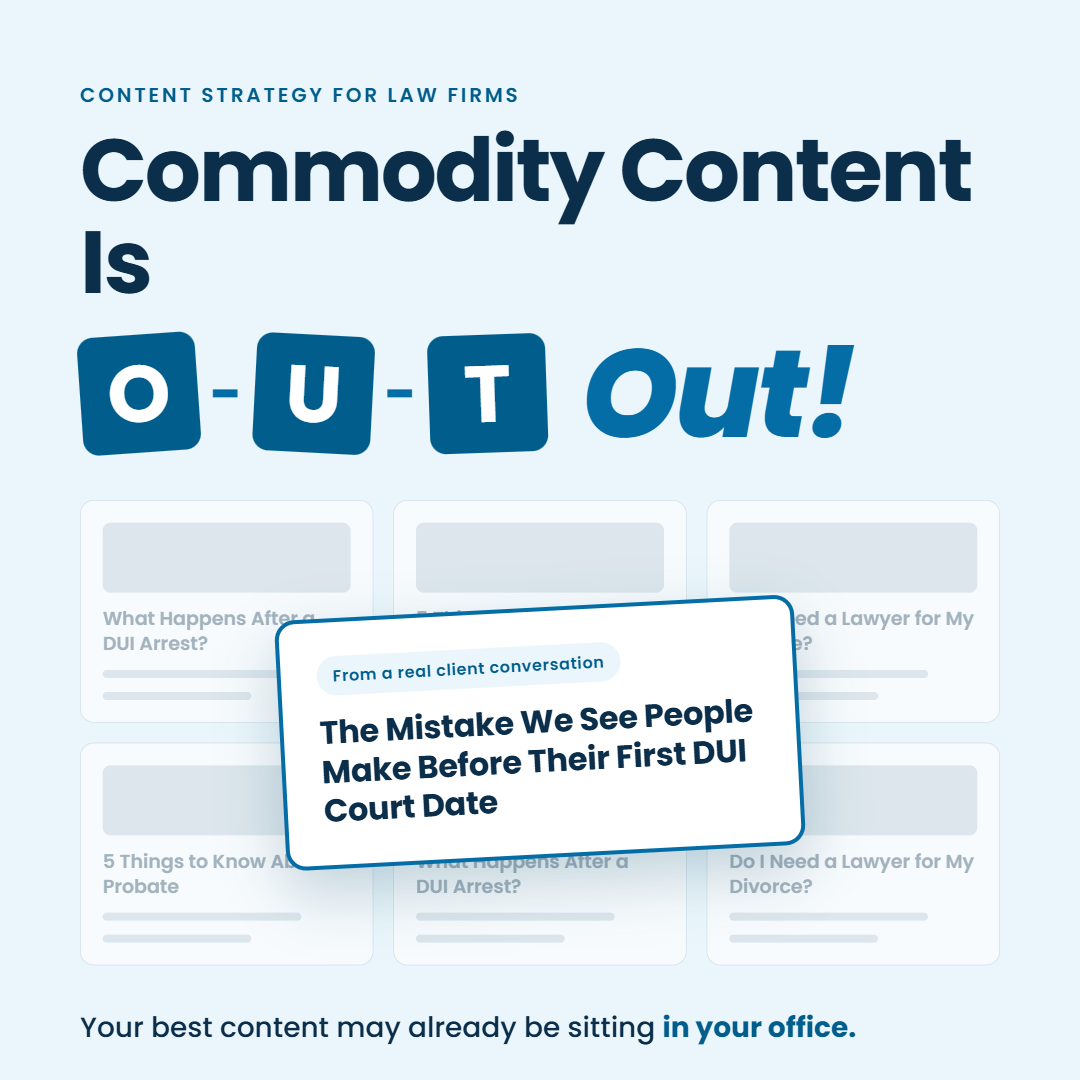
So now there are thousands of versions of the same articles:
What Happens After a DUI Arrest?
5 Things to Know About Probate
Do I Need a Lawyer for My Divorce?
Answering those questions is fine. People really do search for them, and prospective clients need the information. But now you’re competing with dozens, sometimes hundreds, of law firms answering the exact same thing.
And AI can answer most of those questions in a few seconds, usually in the most generic way possible.
So What Is Commodity Content?
Google has been leaning into this language for a while. In May 2025, Google’s John Mueller told site owners to “focus on making unique, non-commodity content.” And at Search Central Live in Toronto this April, Danny Sullivan showed a slide putting commodity and non-commodity content side by side.
Google hasn’t published an official definition, so here’s how I’d put it in plain terms: commodity content is information built on common knowledge. It can be repeated, summarized, rewritten, or generated without adding much to the conversation.
It’s not useless, but it’s everywhere, and there’s very little about it that helps you stand out.
Non-commodity content is the opposite. It’s shaped by firsthand experience, real expertise, original observations, and a point of view that goes beyond what’s already been repeated all over the internet.
And that’s where things open up for law firms.
Your Best Content May Already Be Sitting in Your Office
You don’t have to invent a groundbreaking legal theory every time you publish a blog. Some of your best topics are probably things your attorneys and staff talk about every day.
- What did a client misunderstand this week?
- What question keeps coming up in consultations?
- What mistake do people make before they ever call you?
- What do you find yourself explaining over and over?
Those are content ideas.
Take DUI law. You could write another “What Happens After a DUI Arrest in California?” And if your site needs basic educational content, that’s fine. But an attorney who’s out in the DUI trenches every day has much better things to say. Maybe it becomes:
“The Mistake We See People Make Before Their First DUI Court Date”
“What DUI Clients Usually Get Wrong About Losing Their License”
“Why Trying to Explain Your Way Out of a DUI Can Make Things Worse”
Now there’s something behind the article: experience, pattern recognition, and questions that came from real conversations with real clients.
The same goes for probate. Instead of another “What Is Probate?” article, an attorney could write about what families actually struggle with:
“The Probate Mistake Families Often Make Before They Call an Attorney”
“What Families Should Think About Before Cleaning Out a Parent’s Home”
Those feel different right away, because they’re based on something the attorney has seen, not something anyone could look up.
AI Didn’t Create This Problem
Generic marketing content was around long before generative AI. Businesses have been paying agencies, writers, SEO companies, and content mills for interchangeable articles for years.
AI just made the problem a lot more obvious. I knew it had gone too far when my own therapist read me something like, “Not because you’re broken, but because you’re exhausted.” I wasn’t broken. I wasn’t exhausted. I was annoyed.
If you can type one sentence into an AI tool and get basically the same article your firm was about to publish, pay attention to that.
So, don’t stop blogging. If anything, this change makes your blog more valuable.
Basic answers are easier to get than ever. What’s hard to reproduce is your experience with the question: where clients get confused, what happens when things don’t go according to plan, and what you wish people knew before they walked into your office. That’s the stuff worth writing about.
You Still Need the Basics
Now, none of this means you should start deleting your basic practice-area pages.
People still search for straightforward answers. Search engines still need to understand what your firm does. And sometimes the person who just got a court document at 10 p.m. really does need someone to explain a term in plain English.
Foundational content still has a job, but it shouldn’t be your whole content strategy. Once the basics are covered, your experience should start showing up.
A definition tells someone what something is. An experienced attorney can tell them where people get into trouble with it.
A statute explains the rule. An attorney who works with that rule every day can explain what clients usually misunderstand about it.
Before You Publish, Try This Test
Before your next article goes live, ask one question:
Could another law firm swap in their name and logo and publish this exactly as it is?
If the answer is yes, it probably needs another layer. Here are a few ways to add one:
- Add something you’ve observed.
- Answer the follow-up question clients usually ask.
- Clear up a common misconception.
- Give a real example.
- Talk about the part of the process that surprises people.
The goal is to get the knowledge that already lives inside your firm onto the page.
Your Content Should Sound Like You
There’s already more information online than any of us could ever read. We don’t need another version of the same article.
What we do need is the perspective of someone who’s done the work, answered the questions, seen the mistakes, and learned something worth sharing.
So at your next content meeting, don’t start with what everyone else is writing about. Start with one question:
What did clients ask us this week?
There’s probably a much better article hiding in that conversation. And it’s one that actually sounds like you.
What other “content rules” have you been hearing for years? Let me know in the comments.