
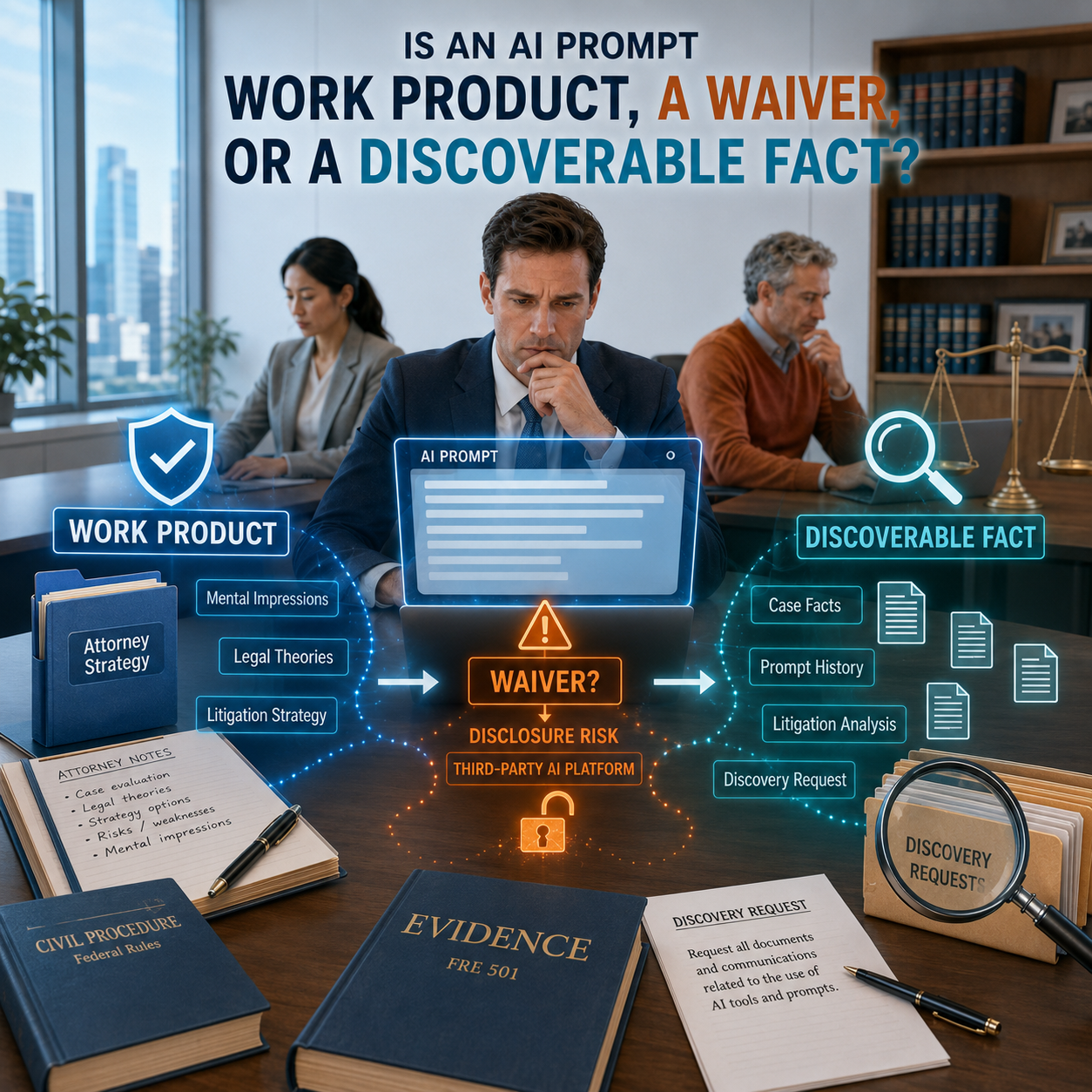
Work product starts with Rule 26 and Hickman.
Federal Rule of Civil Procedure 26(b)(3) protects documents and tangible things prepared in anticipation of litigation or for trial by or for another party or its representative. Even when such materials are discoverable upon a showing of substantial need and undue hardship, courts must protect against disclosure of an attorney’s mental impressions, conclusions, opinions, or legal theories.
That principle traces back to Hickman v. Taylor, where the Supreme Court recognized that attorneys need a zone of privacy to prepare cases without having their files freely invaded by opposing counsel.
Generative AI complicates this doctrine because prompts and outputs can contain both facts and strategy.
A prompt may include a witness chronology. A medical record. A contract clause. A privileged email. A damages theory. A draft pleading. A legal argument. A list of weaknesses. A client’s personal account of what happened.
That is why courts are not likely to treat all AI prompts the same.
The Tremblay lesson: AI testing may be discoverable.
In Tremblay v. OpenAI, the court compelled production of account information, prompts, outputs, and testing documentation related to pre-suit ChatGPT testing. Plaintiffs had offered to produce the prompts and outputs supporting their claims, but resisted producing other testing material. The court rejected the work-product and relevance objections.
For litigators, the practical message is direct: when AI is used to generate factual support for a claim, test examples, create screenshots, compare outputs, or develop evidence, the other side may argue that the prompt history is part of the factual basis of the case.
That is especially true when the party uses selected AI outputs affirmatively.
The Warner lesson: AI use does not automatically waive work product.
The other side of the emerging split is Warner v. Gilbarco. According to Paul Weiss’s summary, the court protected AI-assisted materials created by a pro se plaintiff during litigation, reasoning that they reflected the plaintiff’s internal analysis, mental impressions, and thought process. The court warned against over-focusing on the mere use of AI and noted that treating upload to an AI platform as automatic waiver could undermine work-product protection across modern drafting environments.
This is important. It prevents the simple but dangerous rule that “AI equals waiver.”
The better rule appears to be:
AI use does not automatically destroy protection. But careless AI use may destroy protection.
The Heppner lesson: counsel direction matters.
In Heppner, the court reportedly declined to protect AI-generated materials created outside counsel’s direction and not for the purpose of obtaining legal advice. Paul Weiss notes that Heppner and Warner came out differently in part because the courts characterized AI differently and because counsel direction mattered.
That is a critical practice point. When a client uses AI alone, the interaction looks like a client speaking to a platform. When a lawyer uses a vetted AI system as part of legal analysis, under firm controls, with confidentiality protections, the argument for work product is stronger.
Opinion work product is the danger zone.
AI prompts often reveal more than final work product.
A final brief may disclose the argument the lawyer chose to make. A prompt may disclose the arguments the lawyer considered but rejected.
A final deposition outline may show the questions counsel asked. A prompt may show the fears behind the outline:
“Identify the five most damaging admissions in this transcript.”
“What facts hurt our causation defense?”
“Draft a settlement strategy assuming the judge dislikes arbitration clauses.”
These are not ordinary factual requests. They can expose mental impressions, legal theories, and litigation strategy. Under Rule 26(b)(3), opinion work product receives stronger protection, but that protection becomes harder to defend when the material is placed into an unvetted third-party system without adequate safeguards.
The practical rule for law firms
Lawyers should separate AI use into three categories.
| Category | Example | Treatment |
|---|---|---|
| Public, non-confidential use | “Explain the difference between mediation and arbitration.” | Generally safer. No client facts. |
| Attorney-directed legal work | “Summarize this deposition transcript for impeachment themes.” | Use only approved tools, confirm protective order, preserve as needed. |
| Client self-help AI | “Here is everything that happened. Am I liable?” | High risk. Ask about it at intake and preserve if relevant. |
What lawyers should document
When AI is used for litigation work, counsel should document:
- The approved platform used.
- The purpose of use.
- Whether client confidential information, discovery material, PHI, trade secrets, or privileged communications were entered.
- Whether the use was attorney-directed.
- Whether prompts and outputs were preserved, deleted under policy, or retained by the vendor.
- Whether the protective order allowed the use.
- Whether outputs were relied upon in pleadings, expert work, discovery responses, or settlement analysis.
- This does not mean every prompt must be produced. It means the firm should be able to explain what happened without guessing.
The takeaway
The discoverability of AI prompts and outputs will likely turn on purpose, content, platform, confidentiality, counsel direction, reliance, and timing.
The safest assumption is not that every AI prompt is discoverable.
The safest assumption is that every AI prompt may someday have to be explained.