
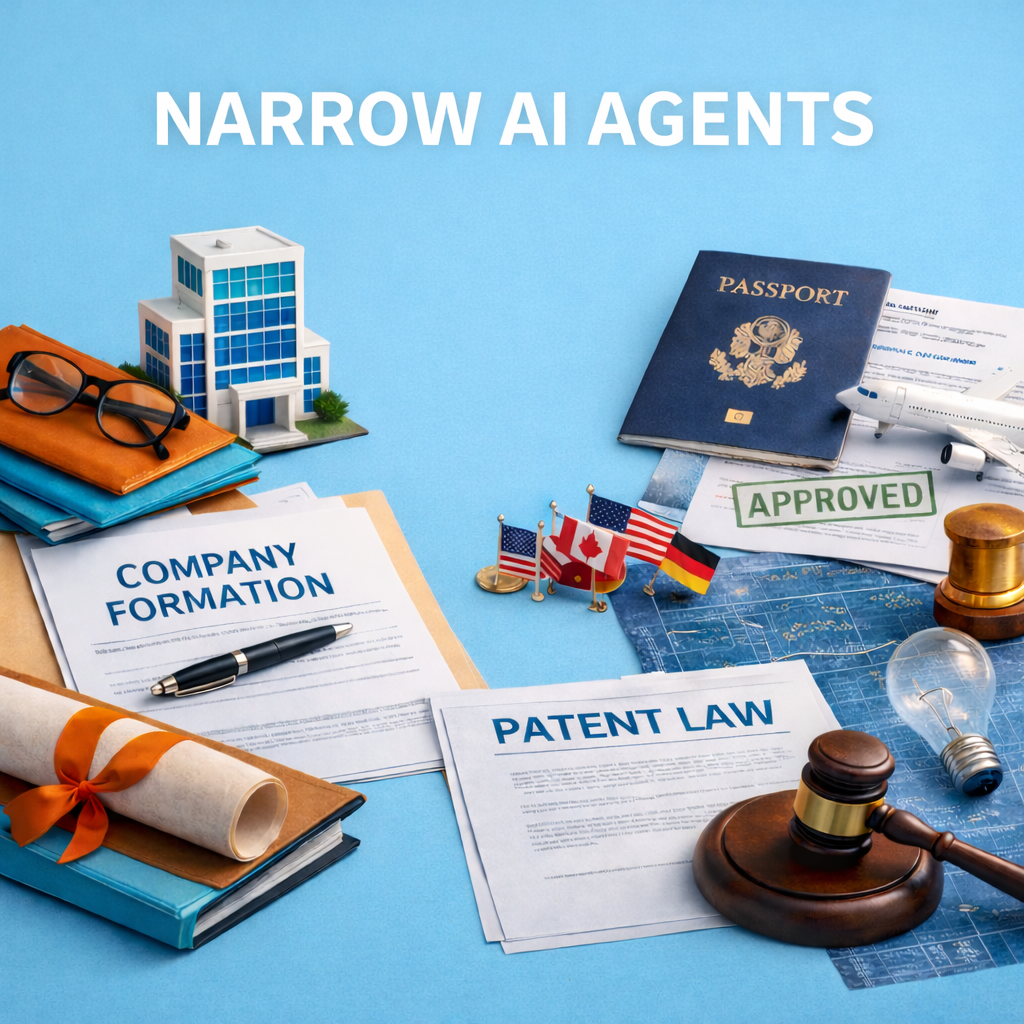
What is a “narrow” AI agent, and why should you care?
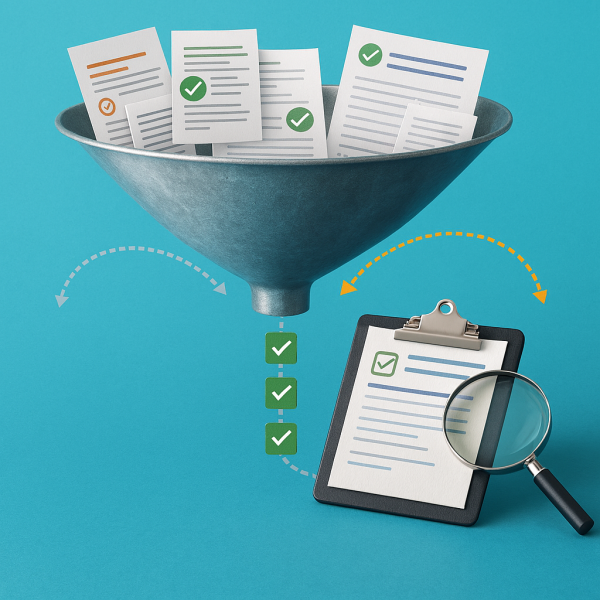 A narrow AI agent is simply an AI system trained and configured to handle one process with clear boundaries.
For example:
- “Guide a client through forming a limited liability company, collect all information, generate formation documents, and create the matter file.”
- “Prepare a first draft of an employment-based immigration petition based on questionnaires and uploaded documents.”
- “Turn an inventor disclosure into a structured patent application, then help respond to office actions.”
The key point is scope.
This is not “do law”.
It is “follow this recipe consistently, quickly, and with full documentation.”
For managing attorneys and office managers, that is good news. It means:
- Easier risk management
- Clearer measurement of results
- Less staff burnout on repetitive tasks
Why these practice areas are such a sweet spot
Company formation, immigration, and patent matters are all very different. They share three operational traits.
- High structure
Forms, checklists, required elements, standard templates. There are playbooks already. - High volume
Firms often run a large number of similar matters across the year. - High stakes, but predictable patterns
Mistakes are costly, yet most cases follow recognizable patterns once you have the facts.
That is exactly where AI agents shine.
They are very good at:
- Gathering information
- Filling forms
- Applying decision trees consistently
- Generating standard documents
- Keeping a clean data trail
They are terrible at being creative geniuses. Fortunately, that is your job anyway.
Use case 1: Company formation and corporate housekeeping
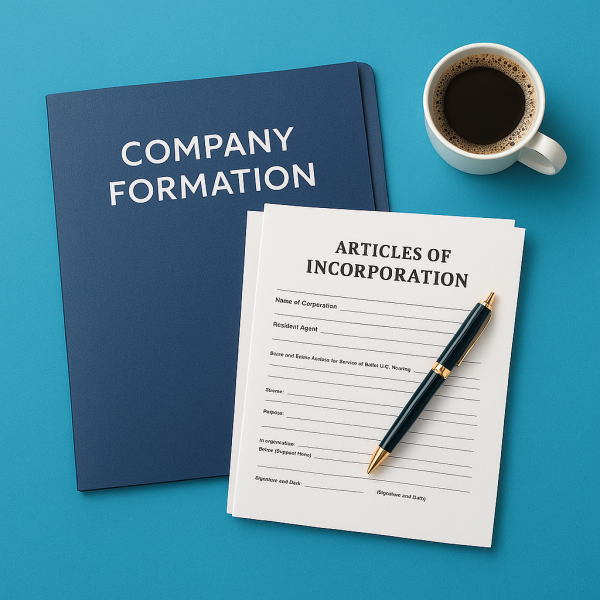 Picture your current process for forming a company:
- Client emails vaguely about “setting up an LLC”.
- Someone sends a questionnaire.
- You chase missing data.
- A paralegal populates forms and drafts basic documents.
- You review, tweak, file, and then manually add the entity details to your systems.
Now imagine an AI agent in the loop.
- A guided intake on your website or via email gathers the right information, in the right order.
- The agent classifies the matter, creates the file, and drafts the formation documents using your templates.
- Once approved, the agent records the new entity details in your practice management and any entity management or cap table tool.
- It sets up reminders for annual reports, resolutions, and key dates.
Your human team still advises on entity type, tax considerations, and any wrinkles. The agent takes the repetitive parts and executes them the same way every time.
For an office manager, this means fewer loose emails, fewer one-off Word documents floating around, and cleaner data in your systems.
Use case 2: Immigration petitions that do not eat the whole week
 Immigration practices often feel like permanent deadline season. Each matter has:
- Long questionnaires
- Many supporting documents
- Strict form requirements
- Detailed narratives
An immigration-focused AI agent can:
- Turn client responses into properly organized evidence lists
- Populate visa forms with data from questionnaires and prior matters
- Draft cover letters and support letters based on standard structures
- Generate a table of contents and cross references
- Produce a compiled package for attorney review
The lawyer still controls strategy, risk assessment, and how the story is told. The agent handles 80 percent of the repetitive assembly.
A nice side effect: junior lawyers and paralegals get to spend more time learning actual law instead of chasing page numbers and retyping passport details.
Use case 3: Patents where the agent loves the details
 Patent work arguably has some of the highest documentation overhead in the profession. Disclosure meetings, prior art, drawings, claims, office actions. It is a lot.
A patent-oriented AI agent can:
- Turn structured inventor questionnaires into draft specifications
- Suggest claim language based on patterns in your existing portfolio
- Cross reference disclosures with known prior art and highlight issues
- Help generate draft responses to office actions, linked to specific paragraphs and references
You as the patent attorney still make all real legal and strategic decisions. You still own the argumentation. The agent just gives you organized, structured material that is faster to refine.
“Is this going to replace my staff?”
If you manage a team, you might be wondering if this is secretly a downsizing discussion in disguise.
Here is the more realistic picture most firms see:
- Fewer overtime hours on repetitive work
- More capacity for higher value matters
- Better onboarding because new team members are not thrown into chaotic processes
- Happier senior lawyers, because the work that reaches them is cleaner and more complete
The firms that use narrow agents effectively tend to redeploy people, not remove them. Staff shift toward quality control, client communication, and more complex work.
You are not replacing people. You are replacing piles of copy paste.
How to design your first narrow agent pilot
 You do not need to reinvent your entire firm. Start small and specific.
1. Pick the right sandbox
Choose a process that is:
- Repetitive
- Document heavy
- Well understood in your firm
Examples:
- Standard limited liability company formations
- A common visa category
- A specific kind of patent application
Avoid the weird edge cases on your first try.
2. Write the “movie script” of the workflow
 Step through the process like you are writing a script.
- Scene 1: How does the client first contact you?
- Scene 2: What information do you need and in what format?
- Scene 3: What documents are created?
- Scene 4: Where are they stored?
- Scene 5: What internal approvals happen?
- Scene 6: What gets filed or sent externally?
- Scene 7: What reminders or follow ups are needed?
For each scene, identify what is:
- Lawyer judgment
- Staff work
- Pure admin
The pure admin steps and some staff work are where agents live.
3. Choose your tools with your eyes open
When you talk to vendors, ask very direct questions:
- “Have you deployed agents in this exact practice area before?”
- “What is the required tech stack? Do you integrate with our practice management, document management, and billing systems?”
- “How do we keep data segregated for different clients and matters?”
- “What controls do we have over what the agent can and cannot do?”
Bonus question: “Show me the audit log.”
If they cannot show a clear log of what the agent did and when, do not use it in client work.
4. Keep humans clearly in charge
For early pilots, make this non negotiable:
- The agent can draft.
- The agent can assemble.
- The agent never sends anything to a client or a government authority without human approval.
Put that in your internal policy. Train everyone that “AI is a tool, not a decision maker.”
5. Track the wins in language partners understand
For managing attorneys and partners, the story is simple:
- “We cut average company formation time from X days to Y days.”
- “We reduced the number of back-and-forth emails with clients by Z percent.”
- “We freed up N hours a month of paralegal time for higher value work.”
You can also track softer benefits:
- Fewer missed steps
- More consistent work product
- Easier coverage when someone is out of office
All of that translates to real business value.
Where this is heading, and why you should not wait
 Today, a narrow AI agent might handle “company formations” or “standard visa petitions”.
Tomorrow, those same foundations expand:
- Company formation agents grow into full corporate housekeeping agents.
- Immigration agents grow into ongoing status tracking and compliance agents.
- Patent agents grow into portfolio management agents that watch deadlines and competitive activity.
Firms that start now build internal muscles:
- How to encode their playbooks
- How to design workflows
- How to supervise AI safely
- How to talk to clients about AI enabled services
That is the real competitive advantage.
 You do not need a grand strategy document to begin. You need one workflow, one clear goal, and the willingness to let a well designed agent handle the boring parts while your people focus on the law.
Your future self, and your future margins, will thank you.