

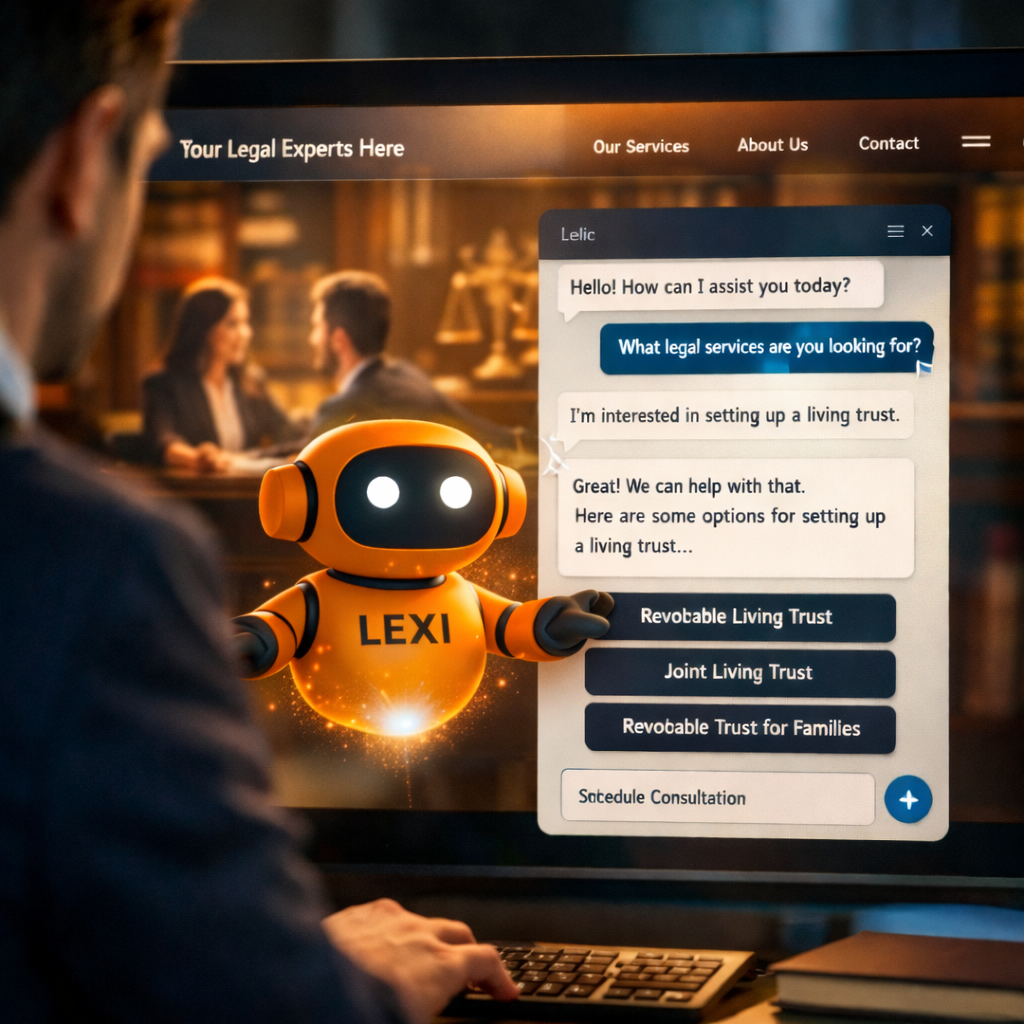
The first direction is marketing, or more precisely, the front door of the firm. Law firm websites are about to become far more conversational. Instead of acting like static brochures with a contact form tucked in the corner, they can become active guides for potential clients. A properly trained AI assistant can answer common questions, explain what the firm does, describe practice areas in plain English, and help a visitor understand whether the firm may be the right fit. That matters because consumers are already using AI and online resources as part of their search for legal help, and Clio reports that many prospective clients are looking online for their next lawyer while AI is beginning to influence those decisions.

The second direction is internal knowledge. Every law firm has an enormous reserve of judgment sitting inside partners’ heads, old briefs, CLE decks, sample documents, presentations, books, articles, and half-forgotten folders with names that suggest nobody should ever open version three. Legal knowledge platforms are already moving toward natural-language questioning over internal documents and turning a firm’s collective expertise into actionable answers. That means the future associate will not always need to interrupt a partner to ask, “What comes next here, and why?” Sometimes the first pass will come from a private AI trained on the firm’s own approved knowledge.

The third direction is even more client-facing. I can see the rise of an AI knowledge partner built around the expertise of a senior attorney for specific, process-heavy practice areas. Think company formation, immigration, intellectual property filings, estate planning workflows, DUI matters, and other areas where clients often have the same questions at the same stages. Legal vendors are already releasing custom AI app builders, configurable workflows, and advanced practice-area workflow tools, which tells me this is not wishful thinking. It is product direction.
Of course, none of this works if firms treat AI like it can walk into the office, put on a tie, and start practicing law. The ethical duties still belong to the lawyers. The ABA’s guidance is clear on that, and Clio’s reporting suggests many firms still do not even have a clear AI policy or that their people do not know whether one exists. So the winners will not be the firms that merely buy a tool. They will be the firms that build guardrails, protect confidential information, supervise outputs, and design smart escalation to human attorneys when facts get messy, unusual, or high stakes.
My view is simple. This is not distant-future talk. Some of these capabilities are already here in early form, and the rest are arriving on a timeline measured in quarters, not decades. Over the next 12 to 24 months, the firms that build thoughtful, private, practice-specific AI systems will not look futuristic. They will just look unusually well run. To me, that is exactly where this is headed.
What do you think is the next real evolution of AI in law? Do you agree it will come from private, practice-specific systems, or do you see a different shift happening first?